
PROGRAMSWhat we actually do
FOUR PROGRAMS.
ONE CHAIN OF
CUSTODY.
Intelligence feeds rescue. Rescue hands off to aftercare. Everything we learn goes back into the next case. The fourth program exists because the people who run the first three came from the ranks of those who respond when everything goes wrong.
 01
0101We hand agencies a case they can charge.
INTELLIGENCE & EVIDENCE
The agencies responsible for investigating trafficking are, almost without exception, overwhelmed. Detectives carry caseloads that make the months of patient link-analysis this crime requires impossible. The result is that solid leads die of a lack of hours.
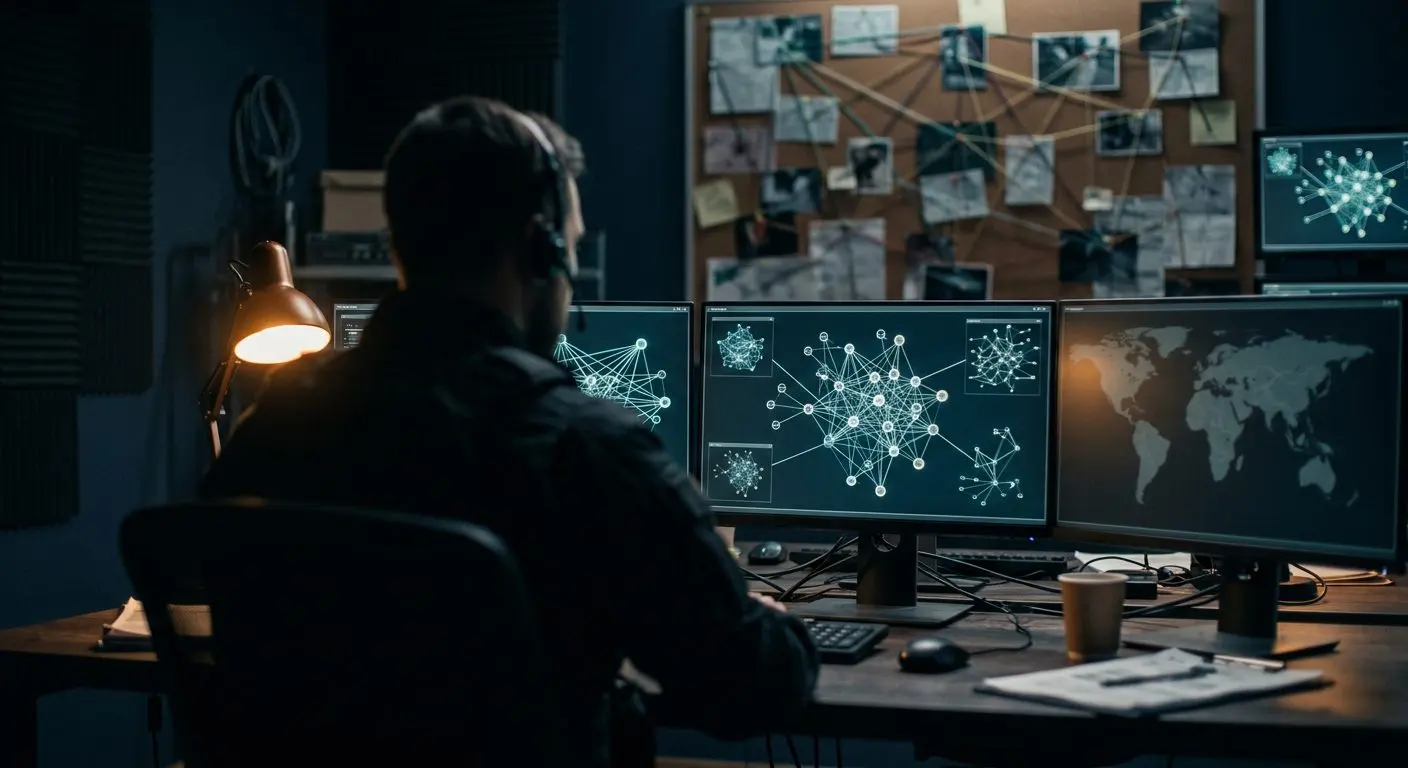
That is the gap we were built to fill. Our analysts take a lead and work it — open-source research, financial pattern analysis, corporate and property records, communications mapping, victim-identification support — and build out the shape of the network behind it.
What that includes
- Network mapping: recruiters, transporters, enforcers, buyers, facilitators and the money that connects them
- Evidence packages formatted for the investigating agency and the prosecutor, not for a press release
- Victim identification and corroboration support, handled so a survivor is never re-traumatized for a file
- Financial tracing through shell entities, front businesses and payment processors
- Ongoing analytic support for the life of the case, including trial preparation
We are not interested in a single arrest that a network absorbs in a week. The objective is always the entire operation.
 02
0202Domestic support. International reach.
RESCUE OPERATIONS
Domestically, we support the agency with jurisdiction. That means planning assistance, surveillance and locate support, medical capability on scene, negotiators when a situation turns into one, and trained advocates ready the moment a survivor is out — so the first hour after recovery is handled by someone who knows what that hour does to a person.
Internationally, where we are lawfully able and formally invited, our team can carry out recovery and repatriation missions in environments that most organizations cannot enter. Those operations are run with host-nation authorities and partner NGOs, never around them.
What that includes
- Operational planning and locate support for law enforcement partners
- Medical personnel and trauma-informed advocates staged for the moment of recovery
- Hostage and crisis negotiation capability
- International recovery, safe movement and repatriation, coordinated with host-nation authorities
- Protective security for survivors, witnesses and safe locations
We do not conduct unilateral action, and we do not publish operational detail. Both rules exist to keep people alive.
 03
0303Rescue is day one of a long year.
SURVIVOR AFTERCARE
The recovery gets the attention. The two years afterward decide whether a person actually gets their life back. A survivor typically comes out with no identification, no money, no housing, untreated medical and dental needs, complex trauma, sometimes a dependency created deliberately to control them, and frequently a legal case they are expected to participate in.
Our job is to make sure none of that is faced alone. We connect each survivor to a coordinated set of services and stay as the constant point of contact while they use them — for as long as they want us there.
What that includes
- Immediate safe housing, then a route to stable long-term housing
- Trauma-informed therapy and psychiatric care, plus substance-use treatment where it is needed
- Full medical and dental care, including care deferred for years
- Document recovery — identification, birth certificates, immigration relief, benefits enrollment
- Legal advocacy through protective orders, custody matters, and testimony if they choose to testify
- Job training, education, financial literacy and employment placement
The measure of this program is not how many people we helped. It is how many are still standing on their own two years later.
 04
0404Giving back to the people who go in first.
FIRST RESPONDERS & DISASTER RESPONSE
A foundation staffed by veterans and former responders was never going to limit itself to one mission. Fire, EMS, dispatch and police personnel absorb the aftermath of everyone else’s worst day, and the cost they carry is chronically under-supported. We give back to them directly.
When disaster hits, we deploy into the window between impact and the arrival of large-scale aid. That is also, uncomfortably, the window in which traffickers move on displaced and unaccounted-for people — so our presence in a disaster zone serves both halves of our mission at once.
What that includes
- Equipment and gear support for under-funded departments and volunteer companies
- Peer support and mental health access for responders and their families
- Rapid deployment after hurricanes, floods, wildfires and earthquakes
- Welfare checks, supply distribution and logistics coordination in the first days
- Anti-exploitation watch in shelters and displacement areas, coordinated with local authorities
Disasters scatter people. Scattered people are who traffickers look for. Showing up early is prevention.
EVERY ONE OF THESE
IS A RECURRING COST.
Analyst hours, safe housing, therapy, travel and gear do not arrive in one-off bursts, which is why a monthly gift is worth several times a single one to us — it is the part of the budget we can actually commit against a survivor’s two-year plan.